TL;DR
To host a Halloween poker night, start after trick-or-treating, keep the buy-in low ($10–$20 for a costume crowd), mix in one or two spooky dealer's-choice games like Midnight Baseball, and run the costume contest from a separate prize pot so it never touches the poker money. Settle with as few transfers as possible before anyone leaves.
From the table
Halloween is the one night a year the poker table looks like a costume party, and the things that go wrong are always the same: a cape sweeps a stack off the felt, the costume prize gets paid out of the game pot, and at 1 a.m. nobody can remember who rebought twice. Decide the money rules before the first deal and the rest of the night takes care of itself.— PartyPot team
A Halloween poker night is a regular home game with three extra moving parts: costumes, a later start, and a crowd that is usually a little looser than your Thursday regulars. None of that changes how poker works, but it does change how you should set the stakes, which games you deal, and how you handle side prizes. This guide covers each one, with a worked example that settles a five-player table in three payments.
When Should You Host a Halloween Poker Night?
In 2026, Halloween falls on a Saturday, October 31, which makes it the easiest Halloween to host in years: nobody has work the next morning. The catch is that anyone with kids is out trick-or-treating until around 8 p.m., and anyone handing out candy is tied to their front door until the doorbell stops.
- Start at 8:30 or 9 p.m. on the night itself, or host on Friday, October 30 if most of your group has young kids. A pre-Halloween Friday game avoids the conflict completely.
- Plan for three to four hours of play. Costume nights start slower (photos, drinks, “who are you supposed to be?”), so a tournament that normally takes three hours will run closer to four.
- Send the money rules with the invite. Buy-in, rebuy limit, costume pot, and how you will settle. People bring the right amount of cash, or know they will be paying by transfer at the end.
What Stakes Work for a Costume Crowd?
Halloween games attract occasional players: a partner who never plays, a neighbour in a great costume, a friend of a friend. Keep the stakes at a level where the biggest loser of the night laughs it off. A useful anchor from our guide to home poker stakes is to give everyone about 100 big blinds for their buy-in, so short stacks can still play real poker.
| Group | Buy-in | Blinds (cash game) | Rebuys |
|---|---|---|---|
| Mixed party crowd | $10 | $0.05 / $0.10 | One, first two hours only |
| Regular group in costume | $20 | $0.10 / $0.20 | Up to two |
| Tournament night | $20, one entry | Blind schedule instead | None, or one re-entry |
A tournament suits Halloween well: one fixed buy-in, a clear finish time, and nobody quietly rebuying a fifth time while dressed as a vampire. If you go that route, the free blind structure calculator builds a schedule from your player count and the time you have.
Which Spooky Poker Games Should You Deal?
Texas Hold'em should still be the main game, because it is the one everyone knows. But Halloween is a good excuse for a dealer's-choice round, and a few classic home-game variants have names and twists that fit the night. House rules for all of these vary from table to table, so the dealer should announce the exact rules before dealing. Pagat's poker variants index has full write-ups if your group wants a reference.
| Game | How it works | Why it fits Halloween |
|---|---|---|
| Midnight Baseball | Seven-card stud dealt entirely face down, and nobody looks at their cards. Players turn cards over one at a time, trying to beat the best hand showing. Threes and nines are wild; a four earns an extra card. | Played blind, “at midnight”. Every reveal is a small jump scare. |
| Black Mariah (High Chicago) | Seven-card stud where the best hand splits the pot with whoever holds the highest spade face down. Some tables end the hand if the queen of spades is dealt face up. | The dark queen decides the pot. Agree on the queen rule first. |
| Follow the Queen | Seven-card stud with queens wild. When a queen is dealt face up, the next face-up card's rank becomes wild too, replacing the previous one. | The wild card keeps shapeshifting, so nobody is safe until the last card. |
| Hold'em with a Dead Man's Hand bounty | Normal Hold'em, plus a small bounty pot (say $1 each). Win a showdown with two pair, aces and eights, and you take it. | Aces and eights is the hand Wild Bill Hickok was holding when he was shot. A house rule, not an official game. |
One round of dealer's choice per orbit is plenty. Wild-card games produce huge hands and big pots, so if you are playing a cash game, consider capping bets in the wild-card rounds so a five-of-a-kind does not wipe out someone's whole night.
How Do You Run a Costume Contest Without Touching the Poker Pot?
The costume contest is where the money most often goes wrong. A host pays the winner “out of the pot”, and at the end the game money is $20 short and nobody can say why. The fix is simple: keep every side prize in its own pot, collected separately at the door and paid out separately.
Worked example: six players, three pots
- Poker pot: $20 buy-in × 6 = $120. Only poker results touch this money.
- Costume pot: $5 × 6 = $30. Best costume wins $20, runner-up wins $10.
- Dead Man's Hand bounty: $1 × 6 = $6. Paid to whoever wins with aces and eights; if nobody does, it goes to the costume winner.
Each pot balances on its own: $120 of poker money comes back out as poker winnings, $30 of costume money comes out as $20 + $10, and the $6 bounty goes to one person. If the poker pot does not balance at the end, you know the problem is a missed rebuy, not the contest.
For the vote itself: everyone gets one vote, nobody can vote for themselves, and voting happens at the first break, so people who leave early still get a say. A tie splits the prize.
Can You Play Halloween Poker for Candy Instead of Money?
Yes, and for a family game or a group of teenagers it is the best version of the night. Candy makes a natural set of chips once you give each type a fixed value:
| Candy | Value | Starting stack (each) |
|---|---|---|
| Candy corn or jelly beans | 1 | 20 pieces |
| Wrapped hard candy or lollipop | 5 | 10 pieces |
| Fun-size chocolate bar | 25 | 2 bars |
That is a 120-point stack per player. Two rules keep it fair. First, eaten candy is out of play: once you eat a chip, it is gone from your stack, and nobody refills it. Second, count every stack at the start and write the totals down, because the whole bag never makes it to the end of the night. Our guide to poker chip substitutes covers other things you can use when there is no chip set in the house.
What Should Be on Your Halloween Poker Night Checklist?
The general hosting basics (food, seating, drinks) are in our ultimate game night planning guide. These are the Halloween-specific items:
- Two decks with different backs. One is shuffled while the other is dealt, which keeps a slower costume crowd moving.
- Mood lighting that still lets people read cards. Candles and orange string lights around the room, a proper lamp over the table.
- Clean snacks. Candy and pretzels, not greasy wings. Sticky fingers and cards don't mix.
- A costume rule for the table. A full mask hides every tell, so agree up front whether masks come off (or push up) while a hand is in play. Long capes and wings come off while seated.
- Space for chips, or no chips at all. Big costumes knock stacks over. Tracking stacks on phones solves that.
- A plan for settling up before people start leaving (see below).
How Do You Settle Up at the End of a Halloween Poker Night?
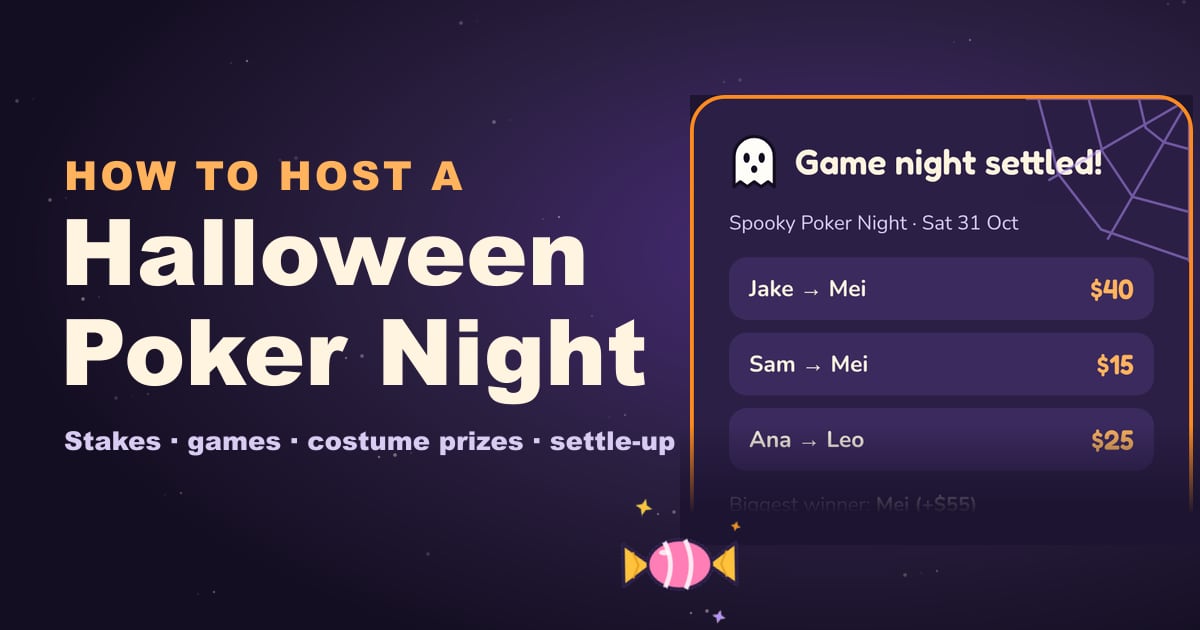
Count every stack, subtract each player's total buy-ins, and you have each person's net result. The results always add up to zero. Then pay with as few transfers as possible: the biggest loser pays the biggest winner first, and you repeat until everyone is square.
Here is a five-player game, $20 buy-ins, at the end of the night:
| Player | Bought in | Final stack | Net |
|---|---|---|---|
| Mei | $20 | $75 | +$55 |
| Leo | $20 | $45 | +$25 |
| Sam | $20 | $5 | −$15 |
| Ana | $40 (one rebuy) | $15 | −$25 |
| Jake | $40 (one rebuy) | $0 | −$40 |
Total bought in: $140. Total in final stacks: $140. Net results: +$80 and −$80. Three payments settle it:
- Jake pays Mei $40.
- Sam pays Mei $15. Mei is now up her full $55.
- Ana pays Leo $25.
If you're doing this on paper, the free poker settle-up calculator works out the shortest list of payments from the final stacks. If the table is already tracking buy-ins in PartyPot, Smart Settlement produces the same list when the host ends the game, and everyone sees it on their own phone.
Running the Game in PartyPot This Halloween
PartyPot is a free digital banker for in-person games: each player joins the host's room by scanning a QR code, buy-ins and rebuys are logged as they happen, and the app works out who pays whom at the end. Nobody has to keep chip stacks safe from capes.
From 30 October to 2 November 2026, the app also runs a Halloween event. The end-of-game summary card gets a Halloween design that you can send to the group chat. Hosts who own the Haunted Table can share it with the whole room. Everyone can throw free candy at the table. Full details are in the PartyPot Halloween 2026 event post.
Get Party Pot Before Halloween Night
Free to use on iOS and Android. Create a room, let players scan in, and settle the whole table in a few payments when the last hand is done.
Related reading: how to host a casino night at home if you want to run blackjack and roulette alongside the poker table; how much money to bring to a home poker night for the full stakes breakdown; and what to do when the chips don't add up if the pot comes up short at the end.
Masks up, cards down, and may the queen of spades be kind. ♠️