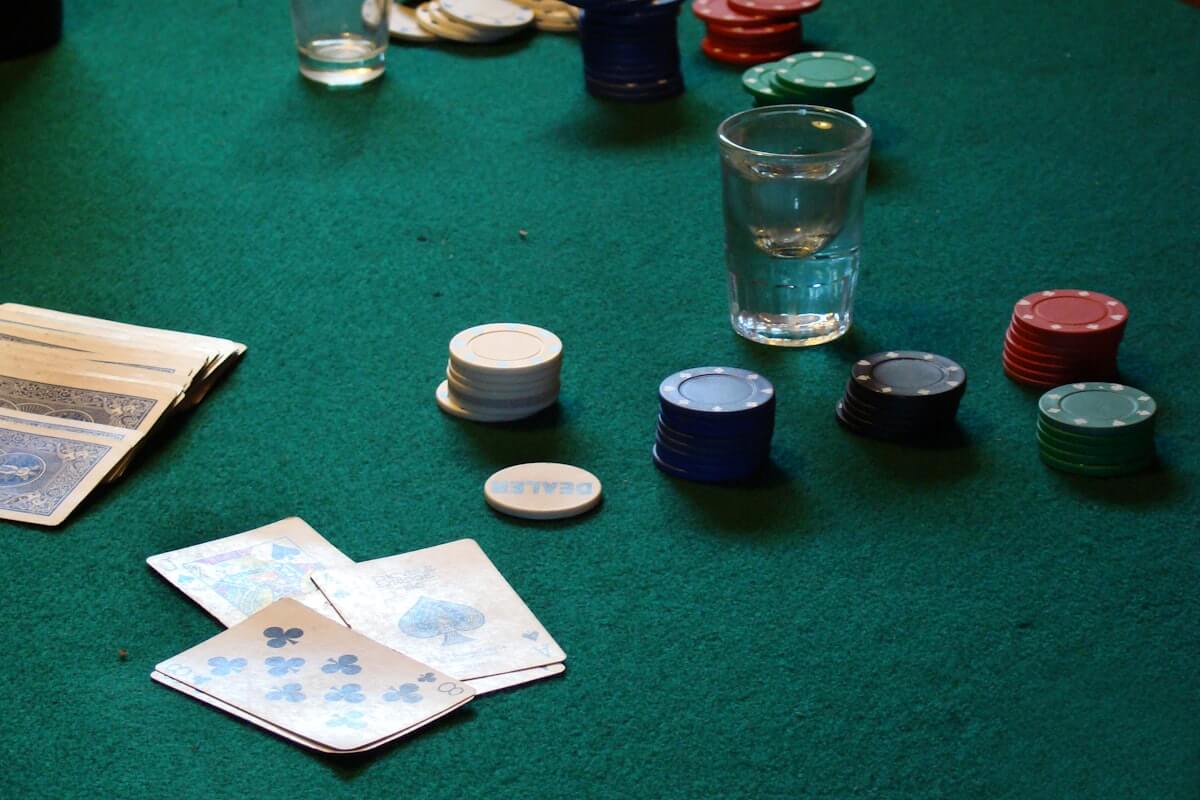
TL;DR
The best substitutes for poker chips, ranked best to worst: (1) a free phone app that tracks virtual chips, (2) coins, (3) Monopoly money, (4) matchsticks, (5) bottle caps, (6) candy, (7) playing cards as chits, (8) dice, (9) IOU paper. A phone app — like Party Pot — wins on accuracy, speed, and zero cost. Physical substitutes are fine in a pinch but mostly just trade one counting problem for another.
From the host
I've genuinely run hands with each of these. M&Ms (someone snacked the small-blind's stack mid-orbit). 20-cent coins (a player palmed five when they folded — accidentally, they claimed). Playing cards as chits (a dog grabbed three off the table). Each substitute has a session it's the hero, and a session where it falls apart on you. Read the ranking with that in mind.— Joelle, PartyPot
It's poker night, someone forgot the chip set, and the dealer is looking at you. You need substitutes for poker chips that actually hold up through a full session — not just the first hand. Here are nine options, ranked by how well they work at a real home game, with pros and cons for each.
1. A Free Phone App (Digital Chips) — Best Overall
A phone app replaces the chip set entirely. Every player has their chip stack on their own phone, every bet is a tap, and the pot counts itself.
Pros: Zero cost, fits in your pocket, exact math on pots and side pots, automatic settlement at the end. No counting errors, no lost chips. Works for any buy-in amount, any blind structure.
Cons: Every player needs a phone with internet. Loses the tactile “shoving chips into the pot” ritual that some purists love.
PartyPot is a free digital-chip app built for this exact use case. See the poker digital chips free-app overview for the full feature list.
2. Coins (Pennies, Nickels, Dimes, Quarters)
The original poker-chip substitute. Pennies = $0.01 chips, nickels = $0.05, dimes = $0.10, quarters = $0.25. Or assign your own values.
Pros: Feels like real poker. Actual currency, so “buy-in” and “cash-out” are literal.
Cons: Heavy. Small denominations make for huge piles. Impossible to do side pots cleanly. Everybody fights over change at settlement.
3. Monopoly Money (or Any Board-Game Money)
Paper money from Monopoly, Life, or any board game. Denominations are already printed.
Pros: Pre-printed denominations remove value disputes. Fast setup if the box is around.
Cons: Paper tears. Awkward to push a stack of paper across the table. Making change takes forever.
4. Matchsticks / Toothpicks
The classic broke-poker-player substitute. Each matchstick = 1 unit.
Pros: Very cheap. Uniform. Easy to count a stack at a glance.
Cons: No denomination variety — you need absurd stacks for a real buy-in. Matchsticks roll. Splinter hazard.
5. Bottle Caps
Beer bottle caps work as uniform chips if you drink enough to collect them.
Pros: Uniform size, flat, stackable. Free if you're saving them anyway.
Cons: All caps look nearly identical, so assigning values is hard without sorting by brand. Sharp edges. Smell like old beer.
6. Candy (M&Ms, Skittles, Starburst)
Assign a color-to-value scheme just like real chips: red = $1, green = $5, blue = $25.
Pros: Cheap, colorful, edible. Good for casual/fun games.
Cons: Players eat the chips. Chocolate melts. The pot becomes a sticky mess. Candy stops being chip-like once you've lost three or four to “I was hungry.”
7. Playing Cards as Chits
Use a second deck of cards. Each card = an assigned chip value.
Pros: You probably already have a second deck around.
Cons: Impossible to stack neatly. Confusing at the table because the chips look like poker cards. Really just a creative workaround that works for one hand.
8. Dice
Use a bucket of d6 dice. Set the face-up pip count to represent your chip balance.
Pros: Interesting novelty. Compact.
Cons: Dice roll when touched. Your stack changes value every time somebody bumps the table. Not recommended except as a gimmick.
9. IOU Paper (The Nuclear Option)
Keep a tally on paper. Everyone writes down their buy-in, adds rebuys, and notes wins/losses.
Pros: Zero equipment needed.
Cons: Slow. Error-prone. You can't track pot and side pots in real time. Somebody always “forgets” a buy-in.
Ranking: Which Substitute Is Actually Worth Using
- Phone app — best on every axis except tactile feel.
- Coins — only real-feel substitute that actually works.
- Monopoly money — acceptable if the box is already open.
- Matchsticks — one-unit stacks only; single-value games.
- Bottle caps — usable if you sort by brand.
- Candy — fine for a casual one-off; expect chip loss.
- Cards as chits — one-hand gimmick.
- Dice — avoid.
- IOU paper — avoid.
Best All-Round: Just Use an App
Physical substitutes are fine for a one-off emergency. For any ongoing home game, a free digital-chip app is faster, more accurate, and free — which beats the zero budget of pennies-and-matchsticks because it also eliminates the counting problem.
Also see the full no-chips home poker hosting guide and the virtual chips for poker, mahjong, and blackjack overview.