TL;DR
Home poker is played with a standard 52-card deck, 2–10 players, and four betting rounds (preflop, flop, turn, river). Players make the best five-card hand they can, rank it against the standard poker hand hierarchy (Royal Flush beats everything; High Card loses to everything), and bet until someone wins. Blinds force action; the button decides who deals; house rules fill in everything the official rules don't cover. This is the complete beginner's guide, written for hosts who are running their first home game.
If you're about to host your first home poker night — or you've been to a few but never been totally sure why the person to the left of the dealer throws in a chip before anyone looks at their cards — this guide covers everything you need. Rules, hand rankings, betting structure, blinds, the button, common variants, and the house rules every responsible host should set before the first hand. And because the hardest part of hosting isn't the cards — it's tracking the money — we'll show you how Party Pot handles the bankroll side so you can focus on the game.
What You Need to Play Poker at Home
The physical supply list is shorter than you'd think:
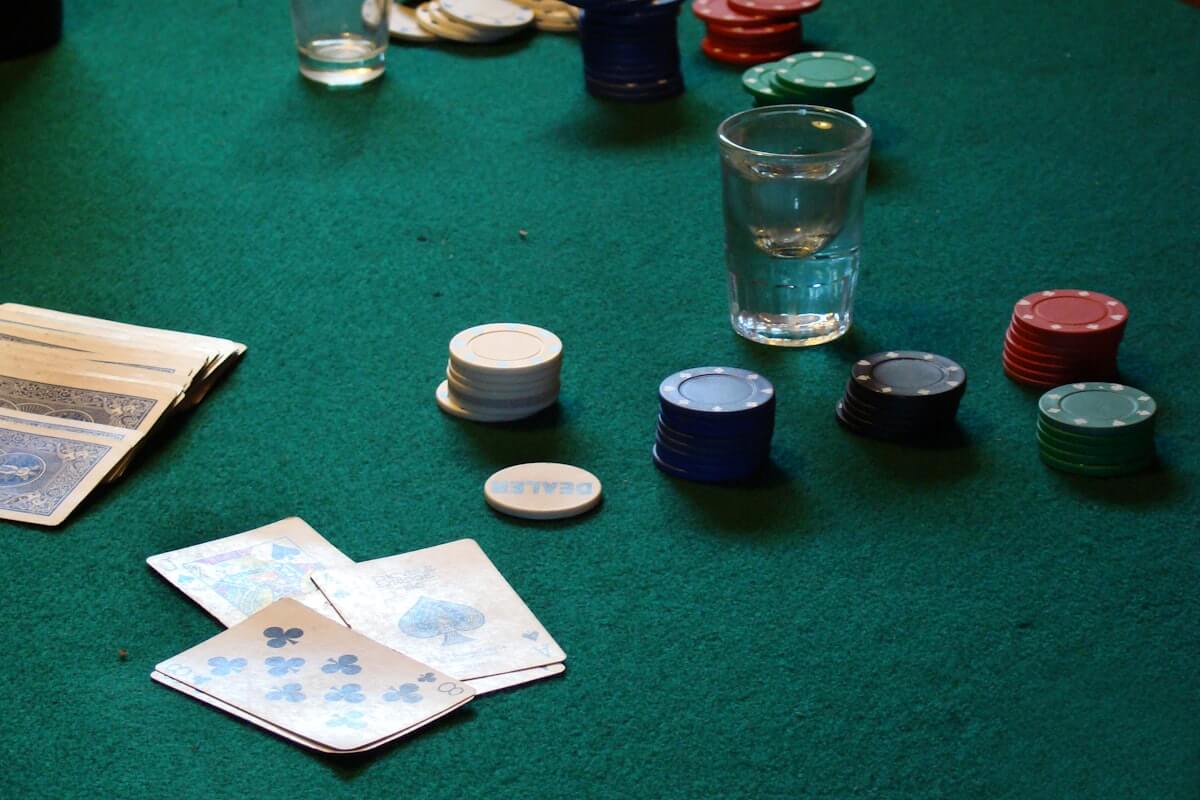
- A standard 52-card deck — one is fine, two lets you alternate so shuffling never slows the game
- A dealer button (optional) — a coin, a poker-style plastic disc, or anything distinctive works
- A table where everyone can see each other — round is traditional, but any shape works
- Chips OR an app — physical chips look classic, but a phone-based ledger like Party Pot is free and skips counting errors. See our chipless home poker guide for the full walkthrough.
- Snacks and drinks — not strictly required, but hosts who skip them don't stay hosts long
The 10 Poker Hand Rankings (Strongest to Weakest)
Every version of poker uses the same hand-ranking system. Memorize this table — it's the single most important reference for any home game.
| Rank | Hand | Description |
|---|---|---|
| 1 | Royal Flush | A-K-Q-J-10, all the same suit. Rarest hand in poker. |
| 2 | Straight Flush | Five cards in sequence, all the same suit (e.g., 8-9-10-J-Q of hearts) |
| 3 | Four of a Kind | Four cards of the same rank (e.g., four 7s) |
| 4 | Full House | Three of a kind plus a pair (e.g., three 9s and two Kings) |
| 5 | Flush | Five cards of the same suit, not in sequence |
| 6 | Straight | Five cards in sequence, mixed suits (e.g., 4-5-6-7-8) |
| 7 | Three of a Kind | Three cards of the same rank (also called “trips” or “a set”) |
| 8 | Two Pair | Two separate pairs (e.g., two Jacks and two 5s) |
| 9 | One Pair | Two cards of the same rank |
| 10 | High Card | None of the above — the highest single card plays |
Tiebreakers: When two players have the same hand type, the higher cards within the hand decide. Two flushes? The highest card in the flush wins. Two pairs? The higher pair wins first, then the second pair, then the “kicker” (the best unpaired card). A calculator is handy the first few times — after that, you'll know it cold.
The Button, the Blinds, and Why They Matter
The dealer button
The dealer button is a small disc (or any marker) that indicates the nominal dealer for the current hand. In a home game, the same person usually shuffles and deals every hand, but the button still moves clockwise after each hand. The button matters because it determines who posts the blinds, who acts first preflop, and who acts last on the flop/turn/river.
The small blind and big blind
Before any cards are dealt, the two players to the left of the button are required to put chips in the pot. These are the blinds:
- Small blind: posted by the player immediately left of the button. Usually half the big blind.
- Big blind: posted by the player two seats left of the button. This sets the minimum bet for the first betting round.
Blinds force action — without them, everyone could just fold forever waiting for premium hands. They also create the pot that everyone is fighting over from the first card.
Suggested blind structures
| Game type | Buy-in | Typical blinds |
|---|---|---|
| Micro cash | $10 – $20 | $0.10 / $0.25 |
| Small cash | $20 – $50 | $0.25 / $0.50 |
| Social cash | $50 – $100 | $1 / $2 |
| Tournament | $20 – $100 | Starts at 25/50, escalates every 15–20 minutes |
The Four Betting Rounds in Texas Hold'em
Every hand of Texas Hold'em — by far the most popular home poker variant — has four betting rounds. Each round follows a deal, and each round gives every active player a chance to act.
Round 1: Preflop
The dealer deals each player two cards face down (the “hole cards”). Starting with the player to the left of the big blind, each player decides to call the big blind, raise, or fold. Action continues clockwise until everyone has either called the highest bet or folded. The player who posted the big blind gets the last option — they can check (if nobody raised), call a raise, re-raise, or fold.
Round 2: The Flop
The dealer burns one card (sets it face-down to the side) and deals three cards face-up in the middle of the table. These are community cards — every remaining player can use them. A new betting round starts with the first active player left of the button. Players can now check if no one has bet yet, or bet/raise/call/fold once someone bets.
Round 3: The Turn
Another burn, then a fourth community card face-up. Another betting round. The minimum bet typically doubles on the turn (“big bet” in limit games; no limit in no-limit games).
Round 4: The River
One more burn, the fifth and final community card face-up, one more betting round. At the end of the river round, if two or more players are still in the hand, we go to showdown.
Showdown
Remaining players reveal their hole cards. Each player's best five-card hand is made from any combination of their two hole cards and the five community cards (you can even use zero hole cards — the board alone — if the five community cards make the best hand). The best hand wins the pot. If two players tie, they split the pot evenly.
The Five Betting Actions Every Player Has
- Check. Pass the action without betting. Only legal if no one has bet in the current round. If someone's already bet, you can't check — you have to call, raise, or fold.
- Bet. Put chips into the pot, forcing others to match, raise, or fold. Only legal if no one has bet yet in the current round.
- Call. Match the current bet to stay in the hand.
- Raise. Increase the current bet. Other players must now match the new higher amount, re-raise, or fold.
- Fold. Throw your cards in and forfeit the hand. You lose whatever you've already put in, but you save everything you haven't bet yet.
Worked example: a 4-player preflop round
- Blinds are $1 / $2. Player A is the small blind ($1); Player B is the big blind ($2).
- Player C (first to act) calls $2. Pot = $5.
- Player D raises to $6. Pot = $11.
- Player A (small blind) folds. Pot = $11.
- Player B (big blind) calls. They already have $2 in, so they add $4 more. Pot = $15.
- Action returns to Player C, who calls the raise by adding $4. Pot = $19.
- Preflop round is over. The dealer deals the flop.
House Rules Every Host Should Set Before the First Hand
Official rules cover the mechanics. House rules fill in the gaps — they're the decisions that vary from home game to home game, and they're the source of roughly 100% of mid-game arguments when they haven't been set in advance.
- Buy-in amount and rebuy policy. Fixed $20 buy-in? Unlimited rebuys or one per player? Set it before anyone sits down.
- String bets. Is reaching into your stack twice to raise allowed, or does “one motion” count as only the first amount? Most home games forbid string bets.
- Verbal declarations bind. If you say “raise” and then change your mind, tough — your verbal call stands.
- Acting in turn. No declaring your action out of turn. Folding out of turn is a courtesy you can still penalize if it telegraphs information.
- Cards-on-the-table rule. Cards that touch the muck are dead, even if mucked by mistake.
- Phone and conversation policy. Is talking about the hand in progress allowed? Most home games say no.
- Rabbit hunting. Looking at what would have come on the turn or river after everyone folded — cute or annoying? House call.
- Who's the banker? Designate one person up front. Switching bankers mid-game is where disputes are born.
Common Home Poker Variants
Texas Hold'em
The default variant for almost every home game. Two hole cards, five community cards, four betting rounds. Easy to learn, hard to master. If you're setting up your first home game, start here.
Omaha (Pot-Limit Omaha)
Each player gets four hole cards instead of two and must use exactly two of them (plus three community cards) to make their hand. More action, bigger pots, more variance. Popular at higher-stakes home games.
7-Card Stud
No community cards. Each player gets seven cards — three face-down and four face-up — and makes their best five-card hand. Five betting rounds. More information on the table, more memory required. Classic older-school home-game variant.
Dealer's Choice
A rotating format where the current dealer picks the variant for each hand. Great for mixing it up; awful if you haven't agreed on the acceptable menu in advance. Set the allowed variants as a house rule beforehand.
Where Party Pot Fits Into a Home Poker Game
Party Pot doesn't handle the cards — you still shuffle, deal, bet, and read your opponents the same way you would with physical chips. What Party Pot handles is everything that used to slow the game down:
- Buy-ins — every player starts with their agreed buy-in loaded into the app
- Blinds — the banker taps the two small-blind/big-blind players and the chips move automatically
- Bets and raises — processed as transfers into the Center Pot
- Pot distribution — winner taps Claim Pot and the total lands in their balance
- Rebuys — banker adds chips with two taps, no physical chip re-stacking
- Side pots — banker marks players all-in, side pots calculate automatically
- End-of-night settlement — Smart Settlement computes the minimum number of transfers to zero everyone out
In other words: Party Pot is the banker. You focus on the game.
Run Your First Home Poker Night With Party Pot
Free. No account. No chip set required. Built for in-person home games.
Want the full hosting walkthrough next? How to Play Poker Without Chips covers buy-ins, rebuys, side pots with worked examples, tournament blind structures, and the end-of-night Smart Settlement flow. For the legal/safety angle, read Are Digital Poker Wallets Safe & Legal for Home Games?
Good luck at your first home game — Party Pot has the bankroll covered. ♠️